
Outpatient neurophysiology
At NEUROTOC we offer a specialized outpatient neurophysiology service for the functional diagnosis of the central and peripheral nervous systems. Our studies include electroencephalography (EEG), electromyography (EMG), sensory and motor evoked potentials, polysomnography, and nerve conduction studies, all performed using state-of-the-art technology by qualified specialists and technical staff.
These tests are essential for detecting neurological disorders in outpatient settings, optimizing clinical referrals, and facilitating treatment monitoring. We collaborate closely with medical centers, insurance companies, and various specialists to integrate the results into the patient’s medical record quickly and effectively.
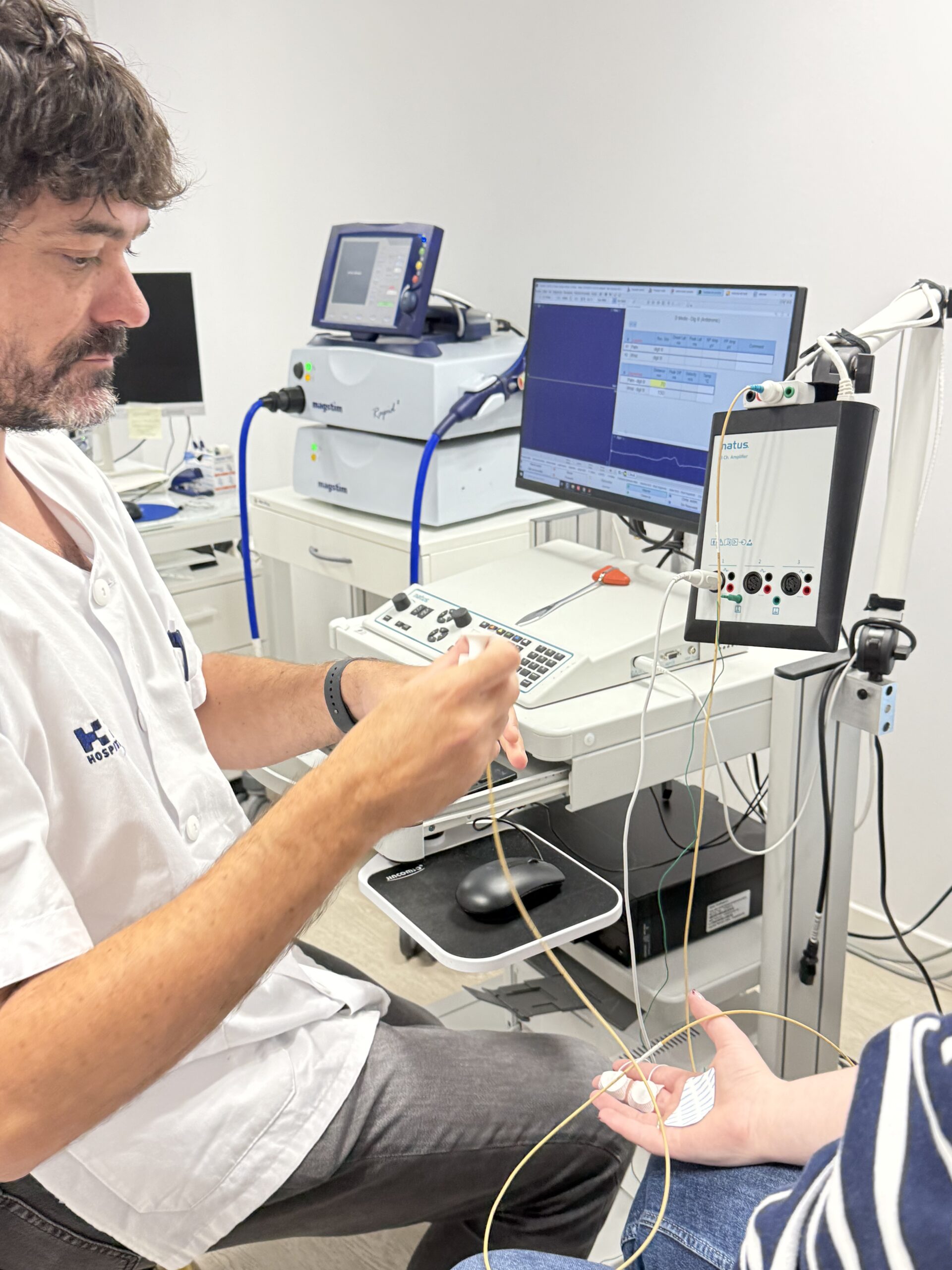
Your trusted partner for ensuring accurate, evidence-based diagnoses
Electroencephalogram (EEG)
Detect abnormal electrical brain activity.
More information
Indications:
Epilepsy.
Loss of consciousness, syncope, or suspected seizures.
Encephalopathies, dementias, etc.
Types:
At rest.
With sleep deprivation.
Prolonged or ambulatory (several hours or days).
Video-EEG (simultaneous video and EEG recording).
Electromyography (EMG)
Suspected myopathies (muscle problems) or motor impairment.
More information
Indications:
Neuropathies (such as carpal tunnel syndrome).
Radiculopathies (nerve compression due to herniated discs).
Electromyography with neurography (EMG ENG)
Evaluates speed, amplitude, and latency of motor and sensory nerves.
More information
Indications:
Suspected neuropathies, radiculopathies, nerve entrapment syndromes, etc.
Somatosensory Evoked Potentials (SSEP)
They evaluate the sensory pathway to the brain.
More information
Peripheral nerves are stimulated (for example, the tibial or median nerves).
Useful in:
Multiple sclerosis, myelopathies, post-surgical monitoring…
Motor Evoked Potentials (MEP)
Stimulate the motor cortex with a magnet (transcranial magnetic stimulation). Evaluate the motor pathway.
More information
Useful in:
Demyelinating or degenerative diseases.
Visual Evoked Potentials (VEP)
The eyes are stimulated with visual patterns. The optic pathway is evaluated.
More information
Useful in:
Optic neuritis, multiple sclerosis, etc.
Thermotest
The Thermotest is a test that evaluates the patient’s thermal sensitivity (heat and cold), through controlled stimulation of the skin with temperature changes.
More information
What it’s used for:
Evaluating small fiber neuropathies (not visible on EMG/ENG).
Diagnosis of neuropathic pain of peripheral or central origin.
Study of complex pain syndromes (such as fibromyalgia or complex regional pain syndrome).
Assessment of sensory disturbances in:
• Diabetes
• Polyneuropathies
• Multiple sclerosis
• Spinal cord injuries.
Potential CHEPS
CHEPS stands for “Contact Heat Evoked Potentials.” It is an objective test to study the function of Aδ and C fibers, responsible for thermal pain (heat) and fine sensation.
More information
Purpose: To evaluate
Thermal and nociceptive pathways (especially small fibers).
Central pain conduction, from the skin to the cerebral cortex.
Uses:
Diagnosis of small fiber neuropathies when EMG/ENG is normal.
Study of neuropathic pain.
Demyelinating diseases (such as multiple sclerosis).
Functional evaluation of nociceptive pathways after spinal cord injuries, trauma, etc.
Use in forensic neurophysiology and assessment of sequelae.
Neurotoc is committed to the latest diagnostic technology.
Diagnostic tests are the most reliable tools for achieving the right treatment for each patient.